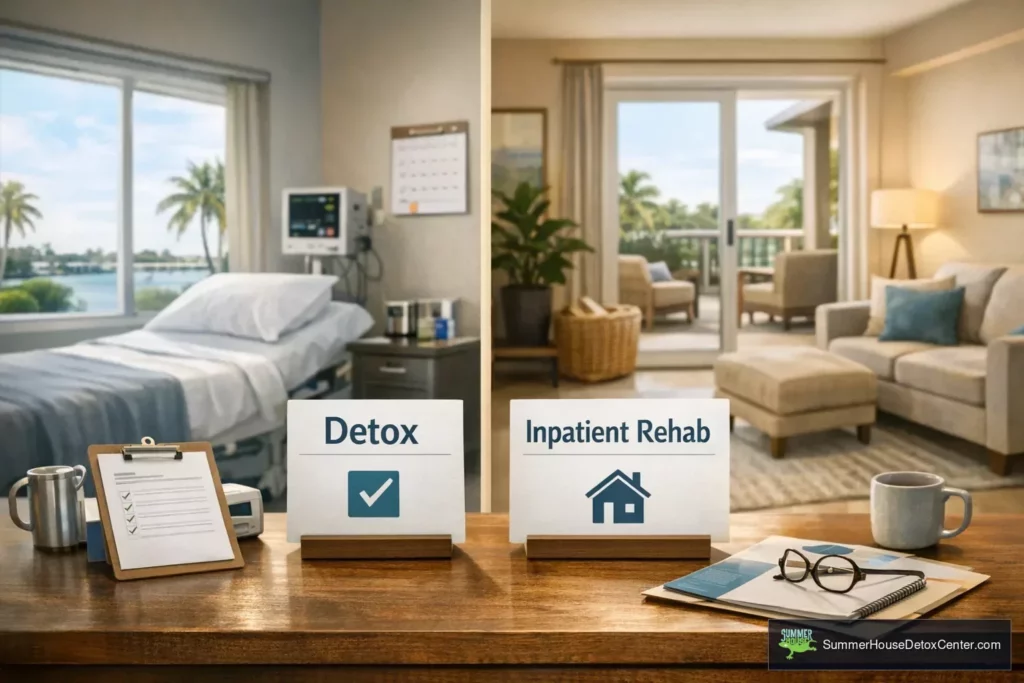
Detox vs Inpatient Rehab Boca Raton: How to Choose the Right Level of Addiction Treatment
If you are comparing detox vs inpatient rehab in Boca Raton, the most important question is not which option sounds easier. It is which level of care actually matches the problem in front of you right now. Detox and inpatient rehab are related, but they do very different jobs. One is focused on safe withdrawal stabilization. The other is focused on ongoing addiction treatment, structure, and recovery work after the body begins to clear substances.
For adults in Boca Raton and across South Florida, choosing the wrong level of care can delay treatment, increase relapse risk, or leave serious withdrawal symptoms unmanaged. That is why it helps to understand what medical detox Boca Raton programs are designed to handle, what inpatient rehab Boca Raton programs are designed to handle, and when a person may need both in sequence.
This guide explains the difference in practical terms, including where outpatient treatment fits, what mistakes families often make, and how to decide on the safest next step for alcohol or drug use. If you want a broader overview of residential treatment options in the area, you can also review rehab boca raton for more local context.
Detox vs inpatient rehab: the core difference
The simplest way to understand detox vs inpatient rehab Boca Raton is this:
- Detox helps a person get through withdrawal as safely and comfortably as possible under medical supervision when needed.
- Inpatient rehab helps a person begin the deeper work of addiction treatment in a structured residential setting after immediate withdrawal risks are addressed.
Detox is about stabilization. Inpatient rehab is about treatment and recovery planning.
That distinction matters because many people say they “need rehab” when what they really need first is withdrawal management, especially if alcohol, benzodiazepines, opioids, or multiple substances are involved. Others assume detox alone is enough because the physical symptoms improve after a few days. In many cases, that is only the first step.
What detox does
Detox is designed to manage the early phase of stopping alcohol or drugs. During this period, a person may experience symptoms ranging from anxiety, sweating, tremors, nausea, insomnia, and agitation to more serious complications depending on the substance, amount used, and medical history. For alcohol and certain sedatives, withdrawal can become dangerous without medical oversight. For opioids and other drugs, symptoms may be intensely uncomfortable and can lead people to return to use quickly if they do not have support.
A medically supervised detox setting may involve:
- Assessment of current substance use and withdrawal risk
- Monitoring for changing symptoms
- Medication support when clinically appropriate
- Help with hydration, sleep, nutrition, and symptom relief
- Planning for the next level of care once the person is stable
If alcohol is part of the picture, readers often find it helpful to review Everything You Need to Know About the Alcohol Detox Timeline to understand how withdrawal can unfold.
What inpatient rehab does
Inpatient rehab treats the addiction beyond the initial physical withdrawal phase. Once the person is more medically stable, residential treatment provides a structured environment away from daily triggers, access to counseling and therapeutic support, recovery education, routine, accountability, and planning for continued care.
In practical terms, inpatient rehab addresses questions detox does not fully solve, such as:
- Why does this person keep returning to alcohol or drug use?
- What triggers, habits, stressors, or emotional patterns are driving the problem?
- What happens after withdrawal ends and cravings, denial, or old routines return?
- What level of support is needed to build momentum in early recovery?
That is why detox vs rehab for alcohol withdrawal is not really an either-or question in many cases. Detox manages the withdrawal. Rehab treats the larger recovery challenge after the most urgent physical symptoms begin to settle.
What problem medical detox is designed to solve
Medical detox Boca Raton services are not meant to “fix” addiction by themselves. Their job is narrower and extremely important: to stabilize a person who may experience withdrawal symptoms after stopping alcohol or drugs.
This can be the right first step when the body has become dependent on a substance and abrupt stopping may cause significant symptoms or complications. Families often underestimate this stage because they focus on the person’s motivation rather than the body’s response. A person can be fully willing to stop and still need medical supervision to do so safely.

When withdrawal management is the first priority
Withdrawal stabilization may need to come first when someone has:
- Daily or heavy alcohol use
- History of alcohol withdrawal symptoms
- Use of benzodiazepines or other sedatives
- Opioid dependence with expected withdrawal
- Polysubstance use
- Medical issues that could complicate withdrawal
- Severe anxiety, agitation, confusion, or insomnia when trying to stop
- Repeated failed attempts to quit because symptoms become overwhelming
For alcohol in particular, this is a safety issue. Alcohol withdrawal can escalate unpredictably for some individuals. That is one reason medically supervised alcohol detox services are often a better option than trying to stop alone.
Detox treats immediate physical instability, not the whole addiction pattern
People searching when detox is enough are usually asking a reasonable question: if the body is through withdrawal, is treatment complete? In some situations, a person may complete detox and then step down to outpatient care if the clinical picture supports that choice. But detox alone typically does not address:
- Cravings after acute withdrawal
- Behavioral patterns around use
- Mental health concerns that may affect relapse risk
- Relationship, work, or legal stress tied to substance use
- Environmental triggers at home
- The need for a structured recovery routine
Detox is a front-end medical service. It is often essential, but it is not the same thing as full addiction treatment.
Examples of situations where detox may be the immediate need
In Boca Raton, a person may be functioning at work, living at home, and still need detox first. For example:
- An adult drinking heavily every night who wakes up shaky and needs alcohol to feel normal
- A person using opioids who wants to stop but cannot get through the first days without intense withdrawal symptoms
- Someone mixing alcohol with pills and experiencing escalating instability
- A family member who has tried to quit at home several times and relapsed quickly because of symptoms
These are not just motivation issues. They may reflect physical dependence that needs closer monitoring.
What problem inpatient rehab is designed to solve
Inpatient rehab Boca Raton programs are designed to treat the ongoing condition of addiction in a structured living environment. If detox handles the crisis of withdrawal, inpatient rehab handles what comes next: how to interrupt the cycle that keeps bringing the person back to alcohol or drugs.
This matters because many people feel much better after a few days of detox and assume they can manage recovery on their own. Unfortunately, the period right after stabilization can still be fragile. Physical symptoms may improve before judgment, coping ability, or relapse risk truly improve.
Primary goals of inpatient rehab
The primary goals of residential treatment usually include:
- Creating distance from everyday access to substances and triggering environments
- Building a structured daily routine
- Beginning therapy and recovery education
- Addressing emotional and behavioral drivers of use
- Evaluating co-occurring mental health concerns that may affect treatment planning
- Developing relapse prevention skills
- Preparing for step-down care such as outpatient treatment, recovery support, or sober living when appropriate
This is why drug detox vs residential treatment is really a comparison of immediate safety needs versus broader treatment needs. Residential treatment is not simply “detox with a longer stay.” It is a different level of care with a different purpose.
Why ongoing treatment addresses more than physical stabilization
Physical stabilization is important, but it does not automatically change a person’s coping style, relationships, thinking patterns, stress response, or environmental risk. Someone may finish detox and still face:
- Cravings triggered by familiar places or people
- Difficulty tolerating stress without substances
- Minimizing the seriousness of the problem once withdrawal fades
- Depression, anxiety, trauma symptoms, or emotional instability that complicate recovery
- Immediate return to a high-risk home environment
Inpatient rehab creates time and structure to work on these issues before the person is back in the middle of daily life. For some, that extra layer of support is what makes the difference between a short-lived detox and a more realistic recovery plan.
When inpatient rehab may be needed even if withdrawal seems mild
Sometimes people do not need intensive withdrawal management but still need residential care. A person may not have severe detox symptoms and still clearly need inpatient rehab because of:

- Repeated relapses after prior treatment or self-detox attempts
- Unsafe or unstable housing
- Strong social pressure to keep using
- Poor outpatient follow-through in the past
- Significant mental health symptoms needing close structure
- Loss of control over substance use despite consequences
So if you are asking when inpatient rehab is needed, the answer is not limited to withdrawal severity. It also depends on relapse risk, safety, support at home, treatment history, and whether the person can realistically engage in recovery without 24-hour structure.
When someone in Boca Raton may need both levels of care
Many people seeking addiction treatment Boca Raton support are best served by both detox and inpatient rehab in sequence. This is common when a person has a clear physical dependence and also needs a structured environment after stabilization.
In this model:
- The person enters detox for assessment, medical monitoring, and withdrawal management.
- Once stable, they transition into inpatient rehab for therapy, structure, education, and recovery planning.
- After residential treatment, they may step down into outpatient care or other continuing support based on clinical need.
This detox-to-rehab path can make sense because it addresses both the short-term and long-term parts of the problem instead of treating only one.
Signs a person may need both detox and residential treatment
- They are physically dependent on alcohol or drugs and likely to have withdrawal symptoms.
- They have tried to stop before and quickly returned to use.
- They have a history of relapse after detox alone.
- They lack a stable, recovery-supportive home environment.
- They need distance from triggers, dealers, or unhealthy relationships.
- They are overwhelmed, ambivalent, or not ready to manage recovery independently after detox.
- They have co-occurring emotional or mental health concerns that call for a more structured setting.
Boca Raton and South Florida context
For adults in Boca Raton, Delray Beach, Fort Lauderdale, West Palm Beach, Pompano Beach, and Miami, one practical reality is that treatment decisions are often influenced by convenience. People may want to stay close to home, continue working immediately, or choose the fastest available option. Those concerns are understandable, but they should not be the only criteria.
South Florida offers access to multiple levels of care, which can be helpful when the right decision is made based on clinical need rather than just location or schedule. If a person needs medical supervision during detox, trying to bypass that stage can create unnecessary risk. If a person needs a structured residential setting after detox, going straight back home may undo the progress made in withdrawal stabilization.
Assessment is what determines fit
The right level of care is usually determined through assessment, not guesswork. A quality screening should look at:
- What substances are involved
- How much and how often they are used
- Previous withdrawal history
- Current physical and mental health concerns
- Any prior treatment or relapse history
- Current living environment and support system
- Ability to stay safe and engaged outside a residential setting
That kind of review helps avoid over- or under-matching a person to care. It also supports appropriate step-up or step-down decisions as needs change.
Common mistakes when choosing between detox and rehab
One reason families struggle with detox vs inpatient rehab Boca Raton decisions is that the wrong factors often dominate the conversation. Here are some of the most common mistakes.
Choosing based only on convenience
A person may prefer to avoid an overnight stay, stay close to work, or return home quickly. But if withdrawal risk is significant, convenience should not outweigh safety. Alcohol, sedative, and complex polysubstance withdrawal can require closer monitoring than a person can get at home.
Choosing based only on price or the shortest path
Trying to choose the “cheaper” or “faster” option can backfire if the level of care is not actually sufficient. A short detox without a real aftercare plan may lead to relapse, repeat admissions, more disruption at home or work, and a longer overall recovery process. The lower-cost choice on day one is not always the safer or more effective choice over time.
This does not mean everyone needs the highest level of care. It means the level should match the risk. Under-treating can be just as problematic as over-treating.
Assuming detox and rehab are interchangeable
They are connected but not interchangeable. Detox handles withdrawal stabilization. Rehab handles the therapeutic and behavioral work of recovery. Confusing the two can lead to unrealistic expectations, especially for families who think a person is “done” once they are physically sober for a few days.
Ignoring co-occurring mental health needs
This is a major issue. Anxiety, depression, trauma-related symptoms, mood instability, and other mental health concerns can affect both detox planning and longer-term treatment planning. A person who appears “fine” physically may still need more structured care because emotional symptoms increase the chance of immediate return to use.

Any decision about when inpatient rehab is needed should consider more than substance use alone. Mental health, functioning, impulse control, and environmental stress all matter.
Believing motivation alone is enough
Motivation is valuable, but it is not a substitute for the right level of care. Many people sincerely want to stop, complete detox, and still find themselves overwhelmed by cravings, triggers, or daily stress without residential or outpatient follow-up. Treatment planning should support motivation with structure.
Skipping the transition plan
Even a strong detox stay can lose momentum without a clear next step. Before discharge, the plan should answer:
- Is inpatient rehab recommended next?
- If not, what outpatient level is appropriate?
- What support will be in place right away?
- What are the immediate relapse risks after leaving?
This is one reason many readers benefit from reviewing The Ultimate Guide to Inpatient Detox and Treatment Centers for a bigger-picture understanding of how treatment levels work together.
How outpatient treatment fits into the decision
The detox vs rehab conversation in Boca Raton often leaves out one important category: outpatient care. Outpatient treatment is not the right starting point for everyone, but it can be an appropriate part of the plan for some people.
In simple terms:
- Detox addresses withdrawal stabilization.
- Inpatient rehab provides 24-hour residential structure and treatment.
- Outpatient treatment provides therapy and recovery support while the person continues living at home or in another community setting.
When outpatient may fit after detox
A person may be able to step down to outpatient care after detox if they are medically stable and have:
- A safe, supportive home environment
- Lower immediate relapse risk
- Reliable transportation and ability to attend consistently
- Enough stability to function outside a residential setting
- Motivation and follow-through for ongoing treatment
This is one version of when detox is enough as the first intensive step: detox may be enough for the withdrawal phase, but not enough for the full treatment plan. The next phase may simply be outpatient rather than inpatient if the person is clinically appropriate for that level.
When outpatient may not be enough
Outpatient may be too low a level of care when someone has:
- Unstable housing
- Severe relapse history
- Continued access to substances at home
- Limited insight or poor treatment engagement
- Co-occurring symptoms that require more supervision and structure
- Repeated failed attempts in less intensive settings
In these situations, recommending outpatient simply because it is more convenient can delay meaningful progress.
Step-down and step-up care should stay flexible
One of the most important ideas in addiction treatment is that levels of care should change based on need. Someone might:
- Start with detox, then step down to outpatient
- Start with detox, then move into inpatient rehab
- Begin in outpatient and later step up if symptoms, relapse risk, or functioning worsens
The goal is not to force everyone into the same track. The goal is to match care to the current level of risk and support needed.
How to choose the safest next step in South Florida
If you are trying to decide between medical detox Boca Raton, residential rehab, or outpatient care, the safest next step is usually a thorough clinical conversation rather than a self-diagnosis based on internet checklists. A few practical questions can help point the decision in the right direction.

Question 1: Is withdrawal likely to be medically significant?
If the person has daily alcohol use, sedative use, opioid dependence, or a history of difficult withdrawal, detox should be discussed first. Withdrawal risk is not something to minimize or guess at.
Question 2: What happens if they go home right after stabilization?
If the answer is “they will be right back around the same people, stress, or substances,” then inpatient rehab may be the safer continuation after detox. If the home environment is safe and supportive, outpatient may be possible instead.
Question 3: What has happened in the past?
Past attempts matter. If the person has already tried quitting at home, completed detox before, or done outpatient unsuccessfully, that history should influence the decision. Repeating a level of care that has not been enough may not be the best plan.
Question 4: Are co-occurring mental health concerns affecting the picture?
If anxiety, depression, trauma symptoms, panic, emotional instability, or other concerns are clearly affecting substance use or recovery engagement, a more structured setting may be warranted. This should be evaluated by qualified professionals, not brushed aside.
Question 5: Can they realistically follow through in a lower level of care?
Some people do well with step-down planning. Others need more containment and routine before they can safely manage recovery in the community. Honesty about follow-through, transportation, home support, and relapse triggers is important.
Practical comparison: detox, inpatient rehab, and outpatient at a glance
Medical detox
- Main goal: Safe withdrawal stabilization
- Best for: Physical dependence, active withdrawal risk, need for monitoring
- Focus: Symptom management, medical supervision during detox, stabilization, discharge planning
- Not designed to do by itself: Full therapy-based addiction treatment or long-term relapse prevention
Inpatient rehab
- Main goal: Ongoing addiction treatment in a residential setting
- Best for: People needing structure, separation from triggers, intensive support, or treatment after detox
- Focus: Therapy, routine, recovery skills, treatment planning, support for co-occurring needs
- Not designed to replace: Detox when medically significant withdrawal is expected first
Outpatient treatment
- Main goal: Ongoing treatment while living in the community
- Best for: People stable enough not to require residential care and able to attend reliably
- Focus: Counseling, recovery support, accountability, continued treatment
- Not ideal when: Home is unsafe, relapse risk is high, or withdrawal requires supervision
FAQ: Detox vs inpatient rehab in Boca Raton
How do I know if I need medical detox or can go straight to inpatient rehab in Boca Raton?
The answer depends largely on withdrawal risk. If you are physically dependent on alcohol, opioids, benzodiazepines, or multiple substances, medical detox may need to come first. A qualified assessment should look at your current use, prior withdrawal history, health issues, and mental health concerns. If withdrawal is not expected to be medically significant, someone may be able to enter inpatient rehab without a separate detox phase. The key is assessment, not guessing.
Is detox enough for alcohol or drug addiction, or do most people need rehab after detox?
Detox is often necessary, but it is usually not the whole treatment plan. Detox helps the body through withdrawal. Rehab addresses the patterns, triggers, coping problems, and recovery planning that detox alone does not resolve. Some people transition from detox into inpatient rehab. Others transition into outpatient care. Whether detox alone is enough for the first phase depends on the full clinical picture, but for many people, ongoing treatment after detox is strongly indicated.
What are the risks of choosing the cheaper or faster option instead of the right level of care?
The biggest risks are under-treatment, relapse, unmanaged withdrawal, and losing momentum. For example, someone may choose outpatient because it seems faster, but if they actually need detox or residential care, they may not stay safe or engaged long enough to benefit. Likewise, detox without a follow-up plan can leave a person physically improved but still highly vulnerable to returning to use. The right level of care should be based on safety and fit, not just speed.
How long does detox last compared with inpatient rehab?
Detox is generally the shorter phase because it focuses on the withdrawal period and early stabilization. Inpatient rehab is longer because it focuses on treatment, therapy, structure, and recovery planning beyond the physical withdrawal stage. The exact time varies based on the substance involved, symptoms, treatment needs, and individual progress. It is better to think in terms of phases of care rather than assume one fixed timeline for everyone.
Can Summer House Detox Center help decide which level of care fits my situation?
Yes. Summer House Detox Center can help you talk through whether the immediate need sounds more like withdrawal stabilization, a structured residential environment, or a plan that moves from detox into rehab. That kind of conversation can help clarify whether you are comparing the right options in the first place and what the safest next step may be in South Florida.
Final thoughts: choose based on what problem needs to be solved first
When people search for detox vs inpatient rehab Boca Raton, they are usually trying to answer a very human question: what should happen next? The most helpful framework is to ask what problem needs to be solved first.
- If the immediate problem is withdrawal risk, medical detox may need to come first.
- If the immediate problem is inability to stay sober outside a structured setting, inpatient rehab may be the next necessary level of care.
- If the person is stable enough to live at home and engage consistently, outpatient treatment may fit as a step-down or direct-entry option.
The safest decision is rarely made by convenience alone. It is made by understanding the role of each level of care, taking withdrawal seriously, considering co-occurring needs, and matching treatment to the person’s actual risk and support needs.
If you are weighing whether someone needs withdrawal stabilization, a structured residential environment, or a full detox-to-rehab plan, Summer House Detox Center can help you talk through the difference in practical terms. Call (800) 719-1090 to speak with the admissions team about what is happening now, what level of care may fit best, and whether medically supervised detox and follow-up treatment in South Florida make sense for the situation.
