The Valium Withdrawal Journey: Understanding Symptoms and Safe Detox
Understanding Valium Withdrawals: What You Need to Know
Valium withdrawals are a serious, sometimes life-threatening medical process that happens when someone stops or reduces their use of diazepam (Valium) after developing physical dependence.
Here’s a quick overview of what to expect:
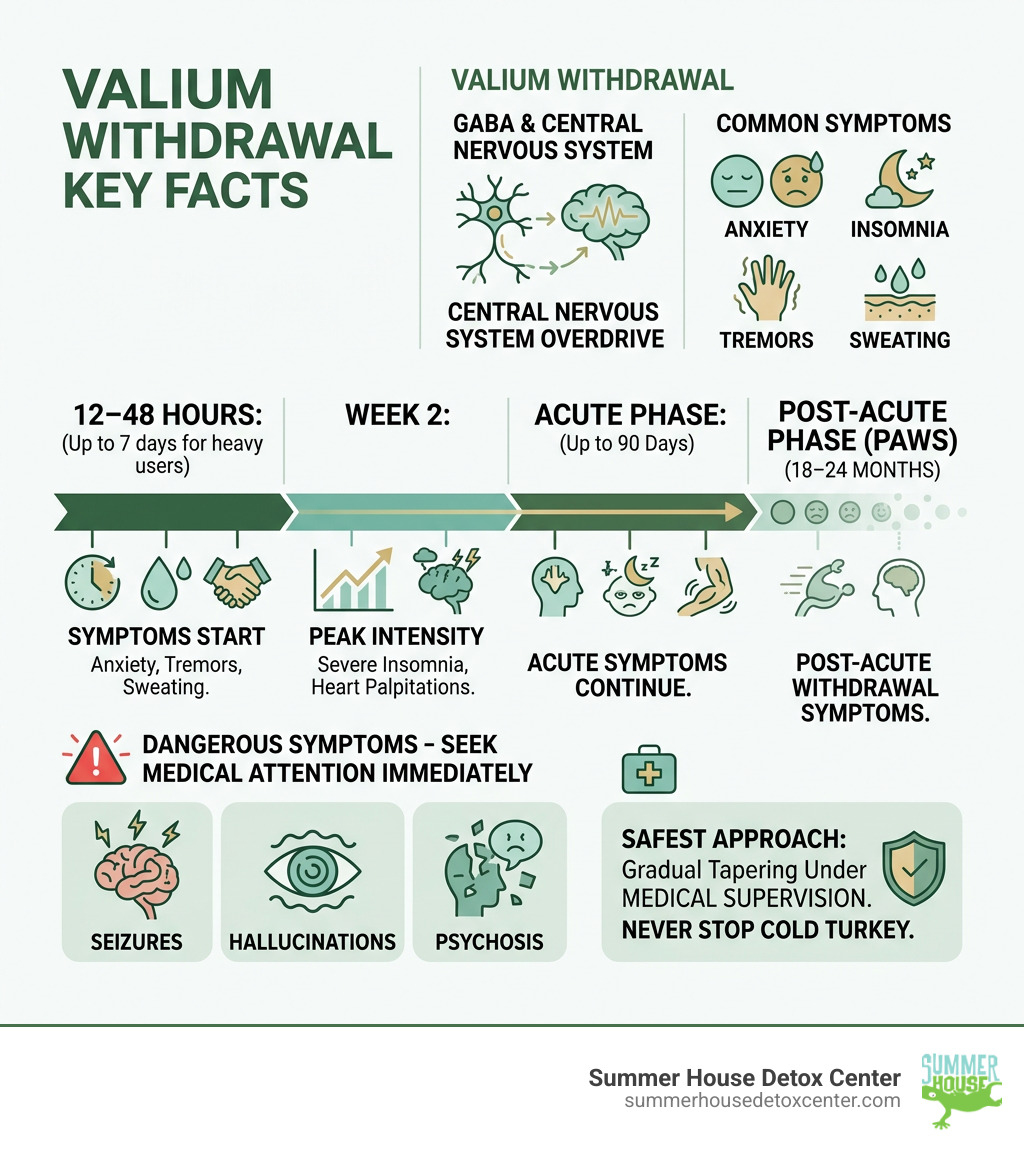
- When symptoms start: 12–48 hours after the last dose (sometimes up to 7 days in heavy users)
- Peak intensity: Around week 2
- Acute phase: Can last up to 90 days
- Post-acute phase (PAWS): Can continue 18–24 months
- Most common symptoms: Anxiety, insomnia, tremors, sweating, heart palpitations
- Most dangerous symptoms: Seizures, hallucinations, psychosis — require immediate medical attention
- Safest approach: Gradual tapering under medical supervision — never stop cold turkey
If you’ve tried to cut back on Valium and felt worse — more anxious, shaky, barely sleeping — you’re not imagining it. That’s your nervous system reacting to the absence of a drug it has come to depend on.
Valium works by boosting a brain chemical called GABA, which calms overactive nerve signals. Over time, your brain stops making enough GABA on its own and relies on the drug instead. When the drug is removed, your central nervous system goes into overdrive.
This is why withdrawal can feel so overwhelming — and why it can be genuinely dangerous without the right support.
You are not weak. Your brain chemistry has changed. And that’s something that requires real medical care, not willpower alone.
Benzodiazepine prescriptions more than tripled between 1996 and 2013, and overdose deaths quadrupled in that same period. In Florida and across the country, thousands of people find themselves physically dependent on Valium — often through a legitimate prescription. If that’s you, safe help is available.
Relevant articles related to valium withdrawals:
Introduction: Understanding Valium and the Mechanism of Dependence
Valium, known generically as diazepam, is one of the oldest and most well-known benzodiazepines on the market. Since its patent in 1963, it has been widely prescribed for anxiety, muscle spasms, seizure control, and even to help manage alcohol withdrawal. However, its widespread use hides a significant risk: the potential for profound physical and psychological dependence.
At its core, Valium is a Central Nervous System (CNS) depressant. It works by enhancing the effects of gamma-aminobutyric acid (GABA), a neurotransmitter that acts as the brain’s “natural brake.” When Valium binds to GABA receptors, it inhibits nerve signals, leading to a feeling of calm and relaxation. While this is helpful for someone in the middle of a panic attack, the brain eventually adapts. It begins to expect the drug to do the work of calming the system down, leading to what we call the dark side of benzodiazepines.
What makes Valium unique compared to other “benzos” is its long half-life. A half-life is the time it takes for the concentration of a drug in your body to reduce by half. For Valium, this can range from 20 to 100 hours. Furthermore, as your liver processes the drug, it creates active metabolites like nordiazepam, which can stay in your system for up to 99 hours. This means that even after you stop taking the pill, the drug lingers, creating a delayed onset for valium withdrawals.
Recognizing Common and Severe Valium Withdrawals
When you stop taking Valium, your brain doesn’t immediately “bounce back.” Instead, the nervous system becomes hyperexcitable. This leads to a variety of symptoms that can affect every part of your body. Common symptoms include:
- Rebound Insomnia: A total inability to sleep, often worse than the insomnia the drug was originally meant to treat.
- Muscle Tremors and Pain: Shaking hands and deep muscle aches are frequent complaints.
- Heart Palpitations: A racing or fluttering heart that can increase feelings of panic.
- Cognitive Impairment: “Brain fog,” difficulty concentrating, and memory issues.
Many people are surprised to find that quitting benzos affects their stomach. You might experience nausea, cramping, or “benzo belly.” To understand this better, you can read about why digestive issues occur during benzo withdrawal.
Furthermore, valium withdrawals are often complicated by co-occurring disorders. If someone was originally taking Valium for anxiety or depression, those symptoms usually return with a vengeance during the detox process, making professional support even more vital.
Identifying Life-Threatening Emergency Symptoms
While many symptoms are just uncomfortable, some are dangerous. If you or a loved one experiences any of the following, seek emergency medical help immediately:
- Grand Mal Seizures: These are the most significant risk of abrupt benzo cessation.
- Toxic Psychosis: Losing touch with reality or experiencing extreme paranoia.
- Delirium Tremens: While more common in alcohol withdrawal, a similar state of confusion and autonomic instability can occur.
- Hallucinations: Seeing or hearing things that aren’t there.
- Suicidal Ideation: Intense feelings of hopelessness or thoughts of self-harm.
If you experience unusual adverse reactions, they can also be reported to the FDA at 1-800-FDA-1088.
The Valium Withdrawal Timeline and PAWS
The journey through valium withdrawals is often described as a “biphasic course.” Because of Valium’s long half-life, you might not feel the full force of withdrawal for several days. Once it starts, it typically moves through an acute phase followed by a much longer protracted phase. Understanding how long benzo withdrawal lasts helps set realistic expectations for the road to GABA rebalancing.
| Feature | Valium (Diazepam) | Xanax (Alprazolam) |
|---|---|---|
| Half-Life | 20–100 Hours | 9–16 Hours |
| Onset of Withdrawal | 1–7 Days | 6–12 Hours |
| Peak Intensity | Week 2 | Days 2–4 |
| Duration of Acute Phase | 2–8 Weeks | 1–2 Weeks |
Managing Acute Valium Withdrawals in the First Month
The first month is the most physically demanding.
- First 24–72 Hours: You may feel relatively fine, or experience mild “rebound” anxiety as the levels in your blood begin to dip.
- Week 2 Peak: This is typically when the most intense symptoms hit. You may experience sensory disturbances, where lights seem too bright or sounds too loud.
- Weeks 3–4: Symptoms often fluctuate. You might have a “good day” followed by a “bad day.” This is the biphasic nature of diazepam as the body struggles to find equilibrium. There are significant Xanax vs Valium withdrawal differences, mainly that Valium takes longer to start but the symptoms may feel less “sharp” than the rapid crash of Xanax.
Understanding Post-Acute Withdrawal Syndrome (PAWS)
For about 10% to 15% of people, symptoms don’t fully disappear after the first month. This is known as Post-Acute Withdrawal Syndrome (PAWS). It represents the brain’s long-term effort at neurological healing.
PAWS can last anywhere from 18 to 24 months. During this time, you aren’t in constant agony, but you may experience “waves” of anxiety, depression, or sleep disturbances triggered by stress. It is a sign of the brain’s previous heavy reliance on the drug, and it requires patience and a solid support system to navigate.
Safe Detox: Tapering, Medical Supervision, and Holistic Care
The golden rule of Valium recovery is: Never stop cold turkey. Abruptly stopping a high dose of Valium can lead to seizures, coma, or even death. The safest way to quit is through a gradual reduction protocol.
Researchers and clinicians often advise a tapering schedule that lasts at least 10 weeks. A common approach is a 5% to 10% dose decrease every one to two weeks, depending on how the individual feels. Interestingly, why benzos are used in detox despite addiction risks is often to help people transition off shorter-acting drugs. Because Valium stays in the system so long, it provides a “smoother” exit than drugs like Xanax.
Safety is also about what you don’t do. We cannot stress enough the dangers of mixing alcohol and benzos. Both substances affect the same receptors, and mixing them exponentially increases the risk of a fatal overdose. Following proven benzo addiction recovery steps is the only way to ensure long-term success.
Why Medical Supervision is Essential for Valium Withdrawals
At Summer House Detox Center in Miami, we believe that no one should have to go through this alone. In-patient medical supervision provides a level of safety that “home detox” simply cannot match.
In a professional setting, experienced staff monitor your vital signs 24/7. We can use supportive medications like clonidine (to help with autonomic symptoms like high blood pressure and racing heart) or other non-addictive aids to ensure you stay comfortable. For those looking for Miami detox options, our facility adheres to the highest Florida medical standards to provide professional benzo detox services that prioritize your dignity.
Holistic Strategies and Lifestyle Changes for Recovery
Detox is about more than just surviving the first week; it’s about rebuilding your health. We advocate for a “whole-person” approach:
- Nutrition: Focus on magnesium-rich foods (like spinach and almonds) and Omega-3 fatty acids to support neurological healing.
- Therapy: Once stabilized, therapies like Cognitive Behavioral Therapy (CBT), Dialectical Behavior Therapy (DBT), and EMDR can help address the root causes of anxiety.
- Sleep Hygiene: Establishing a strict routine helps the brain relearn how to rest without chemicals.
- Exercise: Gentle physical movement can provide a natural serotonin boost, helping to regulate mood.
- Hydration: Flushing the system and maintaining electrolyte balance is crucial for neurotoxin removal.
Frequently Asked Questions about Valium Detox
How long does Valium stay in your system?
Because of its long-acting nature, Valium stays in the body much longer than most other medications. The active metabolite nordiazepam can have a half-life of up to 100 hours. Factors like age (clearance is slower in the elderly) and liver function play a huge role. In some cases, metabolites can be detected in the system for weeks after the last dose.
Can you die from Valium withdrawal?
Yes, though it is preventable. The primary risk of death comes from grand mal seizures caused by abrupt cessation (quitting cold turkey). This is why medical safety protocols and supervised tapering are non-negotiable for anyone who has used Valium long-term or in high doses.
Is Valium more addictive than Xanax?
“Addictive” can be measured in different ways. Xanax is more potent and hits the brain faster, which can lead to a more immediate “high” and rapid psychological addiction. However, Valium’s long-acting nature means physical dependence can sneak up on a person over months of use. Both meet the DSM-5 criteria for substance use disorders and require professional help to overcome.
Conclusion
The journey through valium withdrawals can feel like a long and winding road, but it is one you don’t have to walk by yourself. At Summer House Detox Center, our Miami-based facility is designed to be a sanctuary for those seeking a new beginning. We provide personalized, compassionate care that focuses on your unique needs within the Florida recovery community.
Our staff—many of whom have their own stories of recovery—are dedicated to helping you achieve the high long-term success rates that come with professional medical detox. If you’re ready to reclaim your life from benzodiazepines, we are here to support you every step of the way. Start your journey with professional benzo detox today and discover the freedom of a life lived in balance.
