
Why Inpatient Substance Detox Can Save Your Life
Inpatient substance detox is a medically supervised process where you stay at a facility 24/7 while your body clears drugs or alcohol and trained professionals manage your withdrawal symptoms. If you’ve struggled with addiction and worry about what happens when you stop using, here’s what you need to know:
Key Facts About Inpatient Detox:
- Duration: Most detox programs last 3-7 days, though some substances require up to 2 weeks
- Who needs it: People dependent on alcohol, opioids, or benzodiazepines face life-threatening withdrawal risks without medical supervision
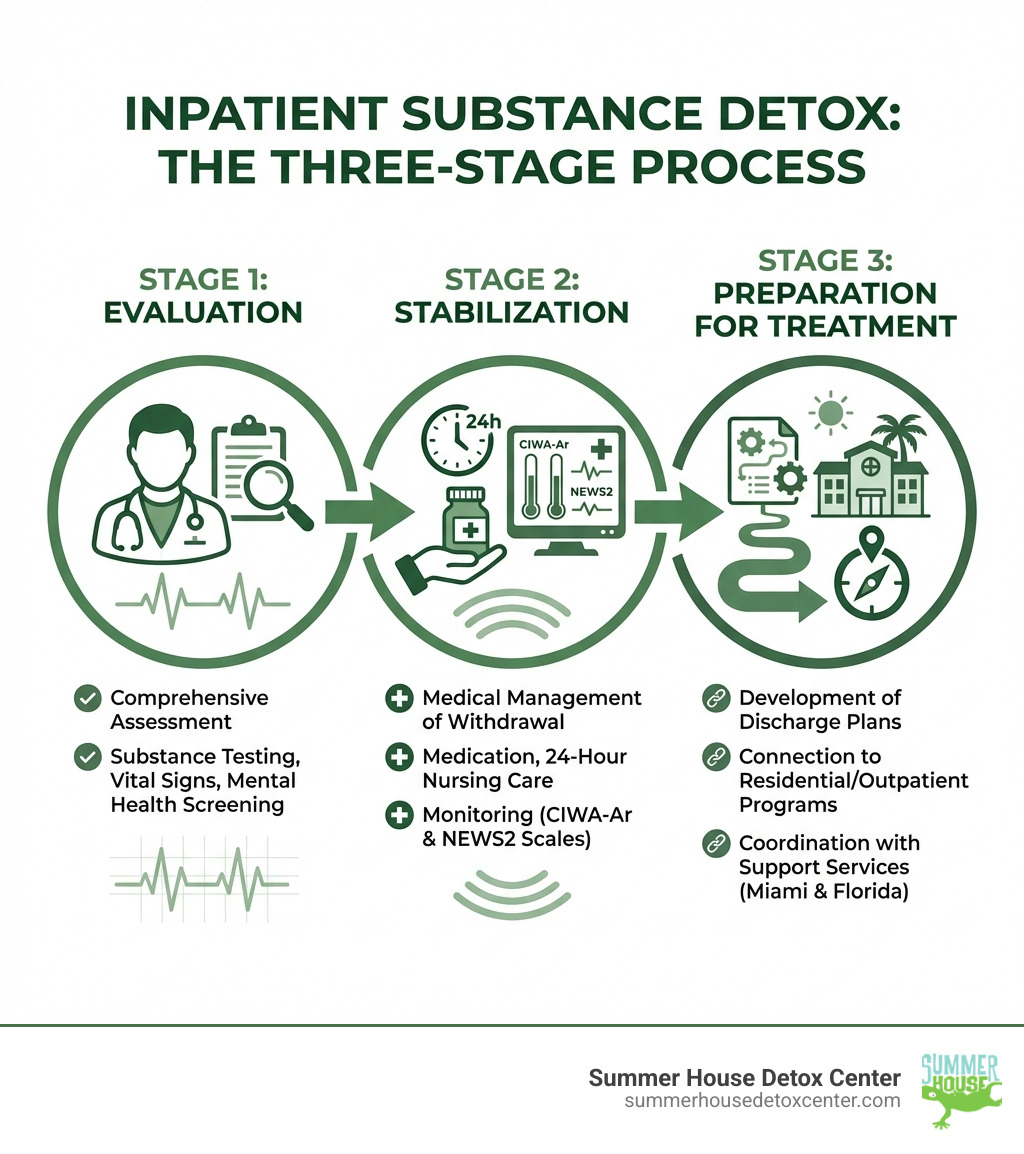
- What happens: A three-step process of evaluation, stabilization with medications, and preparation for ongoing treatment
- Safety: 24-hour monitoring prevents deadly complications like seizures, delirium tremens, and cardiac issues
- Location: In Miami and throughout Florida, facilities provide medically supervised detox in comfortable, dignified settings
Prior to the 1970s, people struggling with alcohol dependence were locked in “drunk tanks” and left to suffer through withdrawal with no medical help. Many didn’t survive. Today we understand that detoxification is a medical process, not a moral failing—and it requires professional care.
If you’re reading this because you’re scared of withdrawal, know this: going through detox alone can be deadly. Alcohol and benzodiazepine withdrawal can cause seizures and death. Opioid withdrawal, while not usually fatal, causes such severe discomfort that most people relapse within hours.
The good news? Medical detox dramatically reduces these risks. You don’t have to white-knuckle it through the worst days of your life. In an inpatient setting in Miami or nearby, nurses and doctors monitor your vital signs around the round, provide medications to ease symptoms, and ensure you’re safe and as comfortable as possible.
Detox is just the beginning—it’s not a cure, but it’s the essential first step. Think of it as clearing the slate so your brain and body can heal enough to engage in real recovery work. Without this foundation, lasting sobriety remains nearly impossible.
Inpatient substance detox terms to know:
Understanding Inpatient Substance Detox and Its Benefits
When we talk about inpatient substance detox, we are referring to the highest level of care available for those beginning their recovery journey. Unlike outpatient programs—where you might visit a clinic for a few hours—inpatient care means you live at our facility in Miami, FL. This environment removes you from the triggers and stressors of your daily life, allowing you to focus entirely on your health.
The primary benefit of an inpatient setting is 24-hour monitoring. Withdrawal is unpredictable. A person might feel fine one hour and experience a sudden spike in blood pressure or a seizure the next. In our facility, medical staff are always on hand to intervene. This constant medical supervision is often the difference between a successful start to sobriety and a dangerous medical emergency.
Why Medical Detox is a Vital First Step in Recovery cannot be overstated. For many, the fear of withdrawal is the biggest barrier to quitting. By providing a safe, controlled environment, we lower that barrier. Our safety protocols include regular checks of vital signs, heart monitoring when necessary, and the immediate availability of physicians and registered nurses who specialize in addiction medicine.
Comparing Detox Options
| Feature | Inpatient Detox (Summer House) | At-Home / Unsupervised Detox |
|---|---|---|
| Medical Supervision | 24/7 access to doctors and nurses | None |
| Medication Access | Prescription meds to manage pain/cravings | Over-the-counter only (ineffective) |
| Safety | High; prevents seizures and DTs | Low; high risk of fatal complications |
| Relapse Risk | Lower; secure, drug-free environment | High; easy access to substances |
| Comfort | High; focus on dignity and support | Low; “cold turkey” is physically agonizing |
The Importance of Medically Supervised Detox: Why DIY Detox Can Be Dangerous is a lesson many learn the hard way. Attempting to “dry out” at home, especially with alcohol or benzodiazepines, can lead to hallucinations, extreme agitation, and life-threatening cardiovascular events. We provide a space where your dignity is preserved, and your physical suffering is minimized through evidence-based medicine.

Clinical Evaluation and Stabilization in Inpatient Substance Detox
The moment you walk through our doors in Miami, our priority is understanding your unique medical needs. We don’t believe in “one-size-fits-all” treatment. The first step is a comprehensive clinical evaluation. This includes a review of your substance use history, physical health, and psychological well-being.
We use standardized tools to ensure accuracy. For alcohol and sedative withdrawal, the CIWA-Ar scale (Clinical Institute Withdrawal Assessment for Alcohol) is our gold standard. It allows our nurses to measure the severity of symptoms like tremors, anxiety, and nausea. If your CIWA-Ar score is greater than 15, or greater than 8 with high-risk factors, inpatient admission is often medically necessary to ensure your safety.
We also utilize the NEWS2 (National Early Warning Score 2) monitoring system. This helps us track your physiological status—like heart rate, oxygen levels, and blood pressure—to catch any signs of distress before they become crises. We also monitor blood alcohol levels (BAL) upon admission. Because the half-life of alcohol is short, BAL can drop rapidly within 12 hours, which is exactly when the risk of withdrawal symptoms begins to peak.
The First 72 Hours of Detox: What to Expect and How to Prepare are often the most challenging. During this window, we focus on stabilization. This means using medications to bring your body back into balance while managing the acute psychological symptoms that often accompany detox, such as depression or suicidal ideation. Knowing What to Expect During Your Detox Experience at Summer House can help ease your anxiety; you will be cared for by people who understand exactly what you are going through—some of our staff members are in recovery themselves.
Managing Withdrawal Symptoms with Medical Interventions
Modern medicine has made it so that no one should have to suffer through the “movie version” of detox—shaking in a dark room and sweating through the sheets. We use Medication Assisted Treatment (MAT) to ease the transition.
- Alcohol Detox: We primarily use benzodiazepines like diazepam or lorazepam on a symptom-triggered dosing schedule. This prevents the brain from becoming over-excited when alcohol is removed, which is what causes seizures.
- Opiate Detox: While opioid withdrawal is rarely fatal, it is famously miserable. We use medications to manage the “bone-deep” aches, nausea, and intense cravings that lead to relapse.
- Benzo Detox: Stopping benzodiazepines (like Xanax or Valium) abruptly is extremely dangerous. We implement a slow, medically supervised taper to protect your brain and nervous system.
Our Detox Services are designed to provide comfort and safety through every stage. By using symptom-triggered dosing rather than just giving medication on a fixed schedule, we ensure you get exactly what you need when you need it—no more, no less.
Withdrawal Timelines and Critical Medical Risks
Understanding the timeline of withdrawal helps us manage expectations. Most people assume they will feel better as soon as the substance leaves their system, but the reality is that the body needs time to recalibrate.
According to the Alcohol Detox Timeline, symptoms usually begin 6 to 24 hours after the last drink. Acute symptoms typically peak around the second day and begin to improve by day five. However, some risks remain high for longer.
Critical Risks We Manage:
- Delirium Tremens (DTs): This is a medical emergency that appears 2 to 4 days after the last drink. It involves severe confusion, hallucinations, and dangerous changes in heart rate and blood pressure. Without medical intervention, the mortality rate can be as high as 5%.
- Grand Mal Seizures: These typically peak within 24 hours of cessation but can occur up to 48 hours later.
- Wernicke’s Encephalopathy: Caused by a severe thiamine (Vitamin B1) deficiency common in heavy drinkers. We provide thiamine injections to prevent permanent brain damage.
- Kindling Effect: This is a phenomenon where each subsequent withdrawal attempt becomes more severe and dangerous than the last. If you have detoxed many times before, your risk for seizures is significantly higher.
Several factors influence the duration of your stay, including the type of substance, how long you’ve been using, your age, and your overall physical health. Hydration management is also a key component of our care; dehydration can worsen withdrawal symptoms and lead to kidney issues, so we monitor fluid intake and provide IV fluids if necessary.
Substance-Specific Timelines for Inpatient Substance Detox
Different drugs “stick” to the body’s receptors in different ways, meaning their withdrawal patterns vary wildly.
- Heroin Detox: Symptoms usually start within 6-12 hours, peak at 1-3 days, and subside within a week. It feels like a very severe flu.
- Methadone Detox: Because methadone is long-acting, withdrawal can be more prolonged. Symptoms might not start for 2-3 days and can last for several weeks. This is why Inpatient Methadone Detox is so critical; it requires a much more gradual taper.
- Suboxone Detox: Similar to methadone, Suboxone has a long half-life. We provide specialized care to help you transition off this medication safely.
If you are searching for “Inpatient Methadone Detox Near Me” in the Florida area, our Miami facility is equipped with the specific protocols needed to handle these long-acting opioids that many standard detox centers struggle to manage.
Dual Diagnosis and the Continuum of Care
Addiction rarely travels alone. Statistics show that approximately 50% of people with substance use disorders also have a co-occurring mental health condition, such as depression, anxiety, PTSD, or bipolar disorder. This is known as a dual diagnosis.
At Summer House Detox Center, we don’t just treat the physical addiction; we look at the whole person. Two-thirds of individuals struggling with addiction have co-occurring mental health needs. If we only treat the detox and ignore the underlying anxiety or trauma, the risk of relapse is incredibly high. Our approach includes:
- Mental Health Integration: Screening for psychiatric conditions during the evaluation phase.
- Trauma-Informed Care: Recognizing that many people use substances to cope with past trauma. We provide an environment that feels safe and supportive, never punitive.
- Staff with Lived Experience: Many of our staff members are in recovery themselves. They offer a level of empathy and insight that you can’t get from a textbook.
What Happens After Detox?
Detox is the “clearing of the ground,” but the “building of the house” happens in the weeks and months that follow. We help our patients transition to the next appropriate level of care within the Florida recovery community. This might include:
- Residential Rehab: Stays of 28 days or longer in a live-in facility focused on therapy and skill-building.
- Intensive Outpatient Programs (IOP): These typically last 3 to 6 months and allow you to live at home or in sober living while attending several hours of therapy per week.
- Sober Living Transitions: We provide referrals to high-quality sober living environments in Miami and throughout Florida to ensure you have a drug-free place to land after treatment.
- Mutual Aid Groups: We help patients connect with Alcoholics Anonymous (AA), SMART Recovery, and other peer support groups that are vital for long-term success.
Our goal is to ensure that when you leave our Miami facility, you aren’t just “clean”—you have a roadmap for staying that way.
Frequently Asked Questions about Inpatient Detox
How long does the inpatient detox process typically take?
Most of our patients complete the acute phase of detox within 3 to 7 days. However, this isn’t a race. Alcohol detoxification can generally be accomplished in 2 to 5 days, while benzodiazepines may require up to two weeks of tapering to be safe. Factors like the severity of your addiction and your medical stability play a huge role. We prioritize your safety over a specific calendar date.
Is inpatient detox covered by insurance in Florida?
Yes, most private insurance plans cover inpatient substance detox because it is considered a medical necessity. Medicare also covers inpatient hospital stays for the treatment of alcoholism and substance use when it is deemed medically necessary by a physician. In Florida, we work with many providers to ensure you get the care you need. We can help you navigate the “medical necessity” documentation and any TAR (Treatment Authorization Request) criteria required by your provider.
What are the signs that someone needs medical detox immediately?
If you or a loved one are experiencing any of the following, seek professional help immediately:
- Hallucinations (seeing or hearing things that aren’t there)
- Severe tremors or “the shakes”
- A history of withdrawal seizures
- Suicidal ideation or extreme depression
- Confusion or disorientation
- High-dose benzodiazepine use (stopping these “cold turkey” is almost always a medical emergency)
Conclusion
At Summer House Detox Center, we know that the decision to enter inpatient substance detox is one of the hardest—and most important—decisions you will ever make. Our Miami-based facility is designed to be a sanctuary where you can begin your journey with the dignity and respect you deserve.
We aren’t just a clinical facility; we are a team of dedicated professionals, many of whom have walked in your shoes. We focus on personalized care, ensuring that your physical pain is managed, your mental health is supported, and your future is prioritized. Addiction can make the future look impossible, but with the right medical support, recovery is within reach.
If you’re ready to take that first step, we’re here to provide you with everything you need to thrive. From the first 72 hours to the moment you transition to aftercare, we will be by your side. Explore our Detox Services today and find out how we can help you reclaim your life.
