COWS and Beyond: A Comprehensive Opiate Withdrawal Symptom Checklist
When Your Body Is Telling You Something Is Wrong: Recognizing Opiate Withdrawal
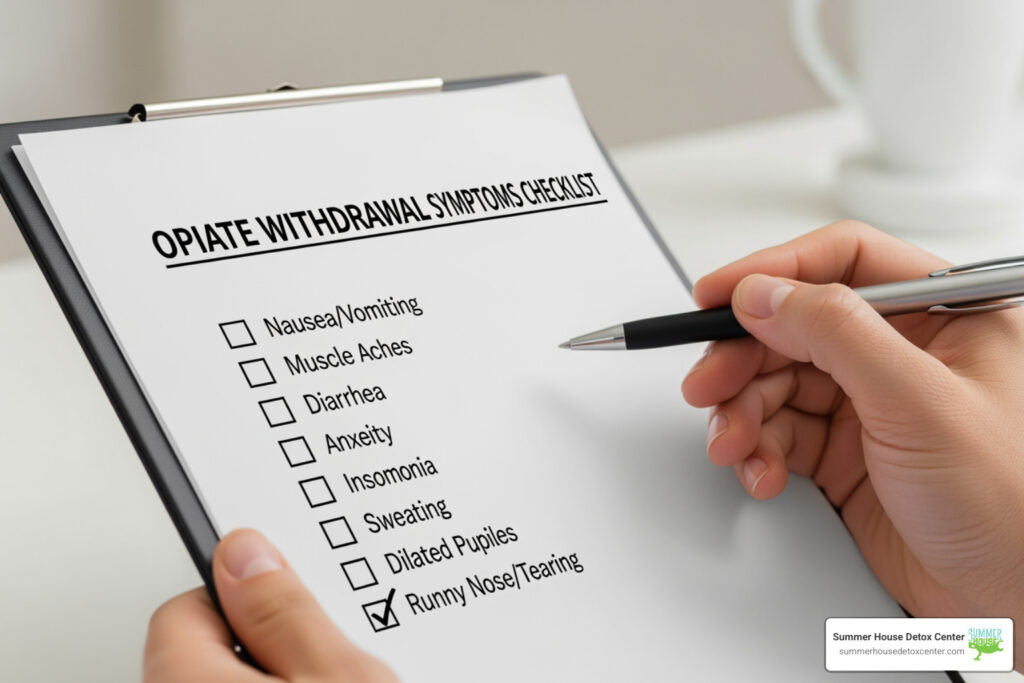
An opiate withdrawal symptoms checklist can help you — or someone you love — quickly identify what’s happening in the body when opioids are stopped or reduced. Here are the most common symptoms to watch for:
Opiate Withdrawal Symptoms Checklist:
- Elevated resting pulse (over 80 bpm)
- Sweating not caused by heat or activity
- Restlessness or inability to sit still
- Dilated (enlarged) pupils
- Bone or joint aches
- Runny nose or watery eyes
- Nausea, vomiting, or diarrhea
- Visible tremors or shaking
- Frequent yawning
- Anxiety or irritability
- Goosebumps (piloerection)
- Insomnia or disrupted sleep
Opioids — including heroin, fentanyl, oxycodone, and hydrocodone — cause the body to physically depend on them over time. When someone stops suddenly, the body reacts hard and fast. The experience is often compared to a severe flu, but it’s more than that.
The discomfort is real. The fear is real. But so is the help available.
For people in Miami and across Florida, knowing what withdrawal actually looks like is the critical first step — whether you’re going through it yourself or watching someone you care about struggle.
The Clinical Opiate Withdrawal Scale (COWS) gives clinicians — and informed families — a structured, 11-point tool to measure how severe withdrawal really is. It removes the guesswork. It guides treatment decisions. And it can be the difference between safe, supported detox and a dangerous situation at home.
Below, we break down the full checklist, how scoring works, what the timeline looks like, and when to get professional help.
Quick opiate withdrawal symptoms checklist definitions:
- clonidine for opiate withdrawal symptoms
- medicine for opiate withdrawal symptoms
- how to ease opiate withdrawal symptoms at home
The Clinical Opiate Withdrawal Scale (COWS) Explained

When someone enters a facility like ours in Miami, we don’t just ask “How do you feel?” and leave it at that. We use the Clinical Opiate Withdrawal Scale (COWS). Developed by Wesson and Ling in 2003, this is a clinician-administered tool designed to provide an objective, reproducible rating of what are the symptoms of opiate withdrawal?
The beauty of the COWS is its objectivity. While many scales rely solely on how a patient describes their pain, the COWS requires a medical professional to observe physical signs. This helps us distinguish between true physical dependence and other conditions. It ensures that when we provide treatment, we are hitting the mark exactly where the body needs it most.
The 11-Point Opiate Withdrawal Symptoms Checklist
The COWS focuses on 11 specific physiological and psychological markers. By scoring each of these, we can get a “temperature check” on the central nervous system’s state of distress. Here is the breakdown of the opiate withdrawal symptoms checklist used in clinical settings:
- Resting Pulse Rate: We measure this after you’ve been sitting or lying down for one minute. A pulse over 80 bpm starts to signal withdrawal; over 120 bpm indicates severe distress.
- Sweating: This isn’t about the Florida humidity. We look for sweating that occurs without physical exertion or high room temperature.
- Restlessness: This is often observed during the assessment. It ranges from being unable to sit still to constant shifting or leg kicking.
- Pupil Size: Opioids typically pin the pupils. During withdrawal, pupils dilate (get larger).
- Bone or Joint Aches: This is a deep, internal discomfort. We only score this if it’s related to the withdrawal process, not a previous injury.
- Runny Nose or Tearing: Also known as rhinorrhea and lacrimation. If you aren’t sick with a cold but your nose is running and eyes are watering, it’s a key indicator.
- GI Upset: This includes nausea, vomiting, and diarrhea. It’s one of the most physically taxing opiate withdrawal symptoms to manage.
- Tremor: We ask patients to extend their hands to check for visible shaking.
- Yawning: Frequent, deep yawning is a classic, often overlooked sign of the brain trying to reset.
- Anxiety or Irritability: This measures the psychological “edge” that comes when the brain is deprived of the substance it has become used to.
- Gooseflesh Skin: Also called piloerection. This is the “cold turkey” symptom where the skin looks like a plucked bird.
Interpreting Your Opiate Withdrawal Symptoms Checklist Score
Once we have a number for each of the 11 items, we add them up. This total score tells us exactly where a person sits on the spectrum of severity.
- Mild Withdrawal (5-12): Symptoms are present but manageable. You might feel like you have a nagging cold or low-grade anxiety.
- Moderate Withdrawal (13-24): This is the “sweet spot” for starting certain medical treatments. Symptoms are clearly visible and uncomfortable.
- Moderately Severe (25-36): At this stage, the physical toll is high. Significant GI upset and intense restlessness are common.
- Severe Withdrawal (>36): This is a state of extreme physical and mental distress that requires immediate medical intervention to prevent complications.
| COWS Score Range | Severity Level | Typical Clinical Action |
|---|---|---|
| 5 – 12 | Mild | Monitoring, hydration, and OTC support |
| 13 – 24 | Moderate | Safe window to begin Buprenorphine (Suboxone) |
| 25 – 36 | Moderately Severe | Intensive medical management and IV fluids |
| Over 36 | Severe | Emergency stabilization and high-level medical detox |
Understanding the Opiate Withdrawal Timeline
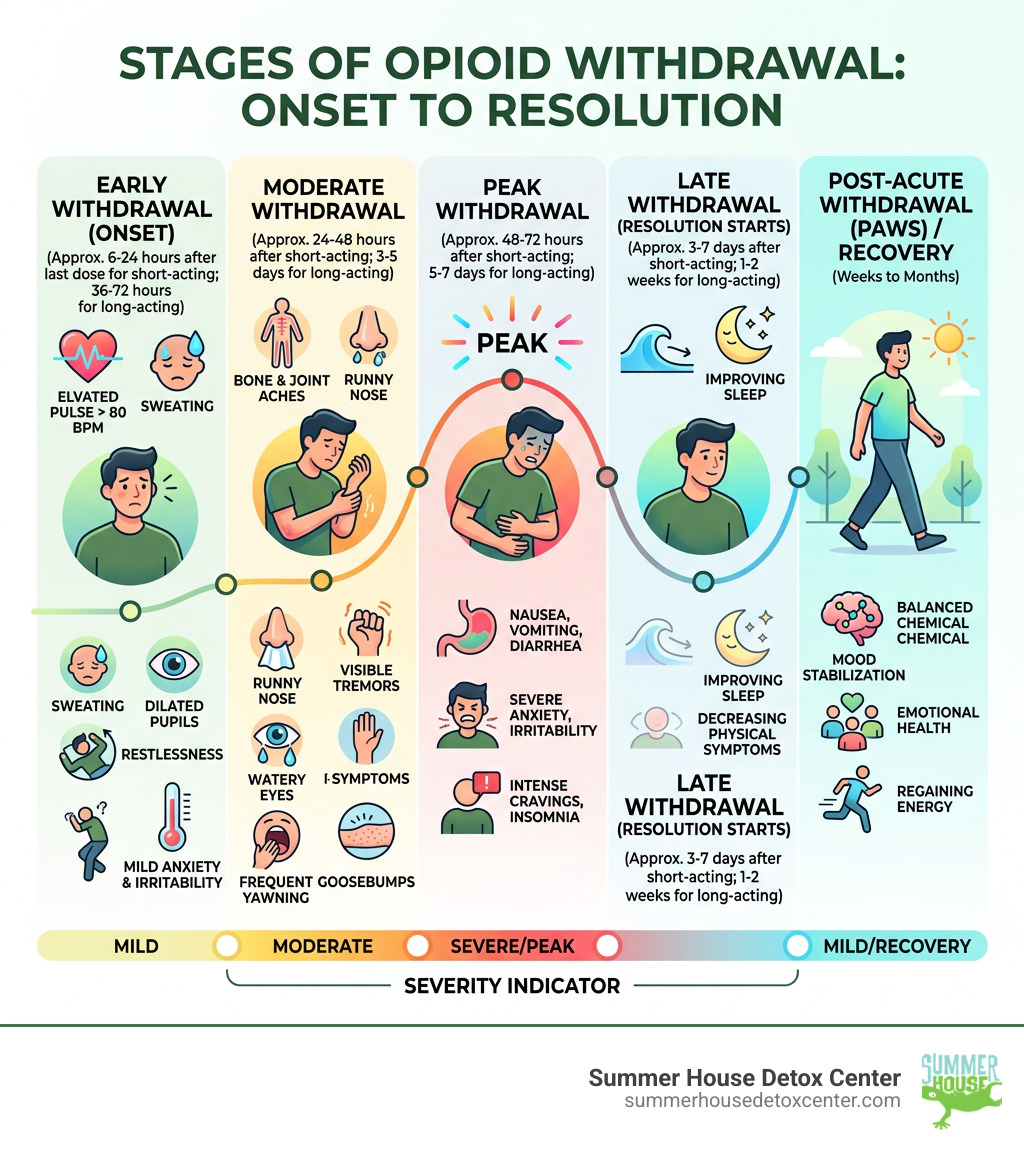
Time feels different during withdrawal. Minutes can feel like hours. However, the biological timeline is fairly predictable based on the type of opioid used. Understanding how long does it take to withdraw from opiates? is essential for planning a successful recovery.
Short-Acting vs. Long-Acting Opiate Withdrawal Symptoms Checklist
The “onset” (when symptoms start) and “peak” (when they are worst) vary significantly:
Short-Acting Opioids (Heroin, Fentanyl, Oxycodone):
- Onset: 6–12 hours after the last dose.
- Peak: Usually within 24–72 hours.
- Duration: Most physical symptoms subside within 5–7 days.
- Note on Fentanyl: Because it is so potent and fat-soluble, the timeline can sometimes be unpredictable, occasionally lingering longer than traditional heroin.
Long-Acting Opioids (Methadone, Extended-Release Morphine):
- Onset: 24–48 hours after the last dose.
- Peak: May not occur for several days.
- Duration: Symptoms can last 14 days or longer.
Regardless of the drug, there is a significant danger in trying to quit “cold turkey.” We often see people underestimate what are the risks of quitting opiates cold turkey?, which include extreme dehydration from vomiting and a dangerously high heart rate.
After the acute phase (the first week), some people experience Post-Acute Withdrawal Syndrome (PAWS). This is a longer-term phase where the brain is still healing, leading to mood swings, sleep disturbances, and cravings that can last for months.
Differentiating Withdrawal from the Flu
One of the most common reasons families miss the early signs of opiate addiction is that withdrawal looks exactly like a bad case of the flu. A loved one might say they have “food poisoning” or a “stomach bug” to cover up their symptoms.
So, how do you know? If you are asking how do I know my loved one is addicted to opiates?, look for these specific “tells” that the flu doesn’t usually cause:
- Mydriasis (Dilated Pupils): The flu doesn’t make your pupils huge. If their eyes look like black saucers even in a bright room, it’s a red flag.
- Piloerection (Goosebumps): While a fever can cause chills, the “gooseflesh” of withdrawal is often more persistent and occurs even when the room is warm.
- Yawning: You don’t usually yawn uncontrollably when you have the flu.
- Restless Legs: The “kicking” or inability to keep legs still is very specific to opioid withdrawal.
In a clinical setting, we use vital signs monitoring to remove the guesswork. While a patient can tell us they feel nauseous, they cannot “fake” a resting heart rate of 115 bpm or dilated pupils.
Medical Management and Safety During Detox
Detox doesn’t have to be a nightmare of pain. Modern medicine has given us incredible tools to “soften the landing.” At Summer House Detox Center, we use a variety of medications to manage the opiate withdrawal symptoms checklist safely.
The Role of Medication-Assisted Treatment (MAT)
One of the biggest breakthroughs in addiction medicine is the use of medications that stabilize the brain’s receptors without producing a “high.”
- Buprenorphine (Suboxone): You might wonder, does Suboxone help with opiate withdrawal symptoms? The answer is a resounding yes. It is a partial agonist that fills the opioid receptors, stopping the “alarm bells” of withdrawal.
- Gabapentin: Sometimes used off-label, people ask does gabapentin help with opiate withdrawal symptoms? It can be very effective for nerve pain, restlessness, and sleep issues during the first few days.
- Clonidine and Lofexidine: These are non-opioid medications that treat the “autonomic” symptoms — things like high blood pressure, sweating, and anxiety.
Home Care vs. Professional Medical Detox in Florida
We often hear from people in Miami who want to try detoxing at home using herbal remedies for opiate withdrawal symptoms? or over-the-counter aids. While hydration and vitamins are great, they often aren’t enough for moderate to severe cases.
The question is opiate withdrawal deadly? is a common one. While the withdrawal itself is rarely fatal for a healthy person, the complications can be. Severe diarrhea and vomiting lead to dehydration and electrolyte imbalances that can cause cardiac stress. Furthermore, the risk of relapse is highest during withdrawal; because tolerance drops quickly, a relapse during this time often leads to a fatal overdose.
Professional Miami detox facilities provide 24/7 supervision. We help you manage the physical pain and also provide guidance on how can I cope with insomnia after opiate detox?, which is often the hardest symptom to kick.
Frequently Asked Questions about Opiate Withdrawal
When is it safe to start Buprenorphine based on the COWS score?
Starting Buprenorphine (Suboxone) too early can cause precipitated withdrawal. This happens when the medication kicks the remaining opioids off the brain’s receptors too violently, causing an immediate, severe spike in symptoms. To prevent this, clinicians usually wait until a patient has a COWS score of at least 12 or 13 (moderate withdrawal). This ensures the body is ready to accept the medication.
Can families use an opiate withdrawal symptoms checklist at home?
Yes, but with caution. There is a tool called the SOWS (Short Opiate Withdrawal Scale), which is a subjective version of the checklist that patients can fill out themselves. Families can use the 11-point list we provided earlier to monitor a loved one. However, if you see signs of severe distress (very high heart rate, inability to keep fluids down, or confusion), it is time to seek professional help immediately.
What are the biggest risks of withdrawing without medical supervision?
The “Big Three” risks are dehydration, cardiac stress, and relapse/overdose. When you stop using, your tolerance for the drug disappears almost overnight. If the withdrawal pain becomes too much and you take your “usual” dose to make it stop, your body may no longer be able to handle that amount, leading to a tragedy.
Conclusion
At Summer House Detox Center, we believe that every person walking through our doors in Miami deserves to be treated with dignity. Withdrawal is a physiological process, not a moral failing. By using tools like the opiate withdrawal symptoms checklist and the COWS scale, we provide a personalized, medically supervised path to sobriety.
If you or a loved one are struggling with the weight of opioid dependence, don’t do it alone. Our Florida opiate detox services are designed to keep you safe, comfortable, and supported every step of the way.
